Residential properties throughout Placer County face substantial seasonal pest activity driven by Mediterranean climate cycles. In northern developments like Fiddyment Farm, Blue Oaks, and Westpark, expansive stucco…
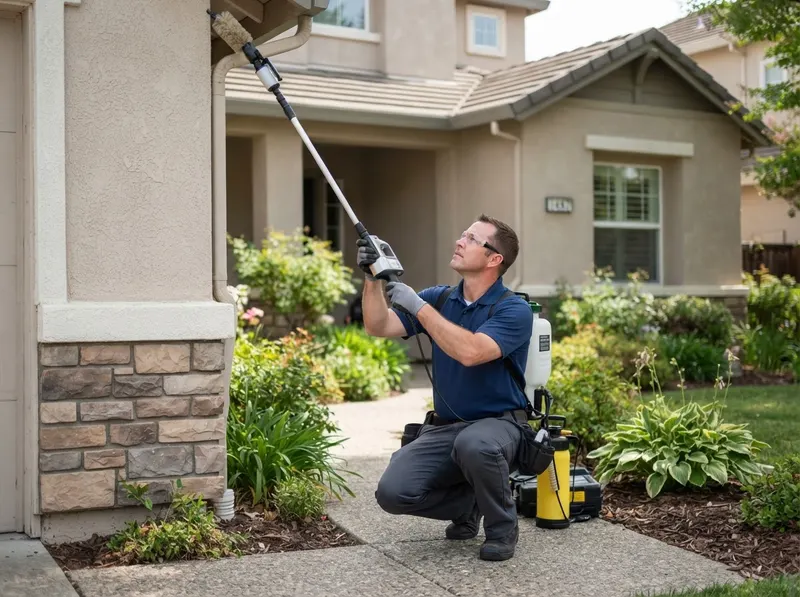
Residential properties throughout Placer County face substantial seasonal pest activity driven by Mediterranean climate cycles. In northern developments like Fiddyment Farm, Blue Oaks, and Westpark, expansive stucco eaves and recessed patio covers provide optimal harborage for Polistes dominula (European paper wasps) and Latrodectus hesperus (western black widows). The presence of automated irrigation networks and lush landscaping adjacent to foundations creates sustained microclimates that attract chironomid midges and turf pests, generating an abundant food web for arachnids. Precision Pest Care deploys an objective diagnostic protocol to systematically break this reproductive cycle across property boundaries without locking clients into indefinite monthly retainers.
Effective perimeter suppression requires direct execution across structural convergence zones. Structural eaves near Mahany Nature Center and Park and riparian corridors along the Miner's Ravine Trail experience accelerated aerial spider drift and aggressive yellowjacket foraging throughout late summer. Technicians utilise telescopic carbon-fibre extension poles treated with pyrethroid dusts to physically strip nesting structures from heights exceeding two storeys, eliminating egg sacs before larvae emerge. Application protocols adhere to standards established by the California Department of Pesticide Regulation, targeting structural void entries, utility penetrations, and foundational weep screeds with microencapsulated barrier agents that resist high UV degradation and heat exceeding 100°F.
Decision parameters determine whether isolated treatments or whole-structure perimeter defenses are appropriate. Single nest knockdown addresses an immediate localized hazard, such as an active aerial nest above an entrance in Sun City Roseville or Highland Reserve, but fails to prevent satellite re-nesting within 14 days. Comprehensive envelope abatement covers the entire physical perimeter, fence framing, and hardscape interfaces, mitigating arachnid migration toward interior baseboards. While barrier applications effectively disrupt predatory insects, they do not resolve unmanaged landscape overgrowth; tree canopies and shrubbery contacting exterior siding must be trimmed back a minimum of 12 inches to disrupt physical bridges.
Regulatory compliance and environmental protection govern all active interventions. Formulations applied to foundation perimeters strictly comply with the EPA Federal Insecticide, Fungicide, and Rodenticide Act and surface water runoff guidelines enforced by the California State Water Resources Control Board. Application rings avoid direct delivery to blooming ornamentals protected under Pollinator Partnership conservation frameworks. Structural inspection standards mirror guidance from the National Pest Management Association and residential safety measures supported by the Occupational Safety and Health Administration. Environmental controls reflect vector management protocols detailed by the California Department of Public Health, the UC Statewide IPM Program, the Placer County Agriculture Department, and building envelope parameters verified through the International Code Council.
Every job gets a firm, written price after a free on-site visit.
For standards, safe disposal, and service guidance on pest control services in Roseville, CA, useful references include U.S. EPA, ENERGY STAR, U.S. Dept. of Energy, Consumer.gov, U.S. Census Bureau, and Google Maps. General consumer and small-business resources are available from USA.gov, Better Business Bureau, FTC Consumer Advice, U.S. Small Business Administration, and Ready.gov.
Tell us about your exterior spider and wasp abatement job in Roseville and we'll send a clear, written quote, usually the same day.
 Precision Pest Care